🇫🇷 Sarlat & the Dordogne Valley – Medieval Villages, Magnificent Castles & Beautiful Gardens
Our Dordogne Adventure

The Dordogne has become one of our favourite regions of France, and somewhere we've been lucky enough to explore on several occasions. With our daughter Abbie and granddaughter Mia living nearby, we've had plenty of opportunities to discover its beautiful villages, magnificent castles, wonderful gardens and spectacular countryside.
During our year out in 2024, we spent eight weeks in southwest France, including four wonderful weeks based near Saint-Nathalène, just 10 km from Sarlat-la-Canéda. Having a whole month to explore meant we could take things at our own pace, discovering somewhere new one day and simply enjoying the French countryside the next.
From wandering medieval streets and visiting imposing castles to canoeing along the Dordogne River and walking through beautiful gardens, this region has so much to offer.
Here are some of our favourite places and experiences from our time exploring Sarlat and the Dordogne Valley.
🏡 Where We Stayed – Saint-Nathalène

For the first four weeks of our stay, we rented Gîte Pont Vue, a lovely two-bedroom property in the small hamlet of Le Montal, approximately 2 km from Saint-Nathalène.
Surrounded by rolling countryside, wheat fields and peaceful walking trails, it was a wonderful place to experience rural French life.
The accommodation was spacious, comfortable and well equipped, with beautiful countryside views. We particularly appreciated having a proper kitchen, laundry facilities and somewhere to work on our travel videos.

An added bonus was access to the facilities at a nearby campsite, just a few minutes' walk away, including a swimming pool, tennis courts and restaurant.
With Mia joining us at weekends and Teddy enjoying the countryside walks, it really did feel like a home away from home.

Our tip: If you're planning to explore the Dordogne for more than a few days, staying in a rural gîte is a wonderful alternative to a hotel. You'll have more space, the freedom to cook using delicious local produce and the opportunity to experience a slower pace of life.
🏰 Sarlat-la-Canéda – The Heart of the Dordogne
Sarlat quickly became one of our favourite towns in the region. We have visited in all seasons, off peak in May, high season in August and at Christmas.
It is famous for its beautifully preserved medieval architecture, Sarlat is a maze of narrow cobbled streets, honey-coloured stone buildings,

attractive squares and little boutiques.
We particularly enjoyed arriving early in the morning, before the streets became too busy, and settling into a café in the main square with a coffee and an enormous croissant.

One of the highlights is the impressive indoor market, housed in the former Sainte-Marie Church. The building was transformed by architect Jean Nouvel, who added enormous contemporary metal doors that contrast beautifully with the historic stonework.
Inside, you'll find a wonderful selection of local produce, including walnuts, cheeses, pâtés and other regional specialities.

Away from the main square, we loved exploring the quieter streets, discovering art galleries, independent shops and little restaurants tucked away in historic buildings.
Sarlat is particularly atmospheric on market days, although it can become extremely busy during the summer months.
We also visited in winter. Sarlat has an excellent Christmas market usually opening around the 2nd Dec. We visited in Dec 2023 for Christmas with family. Here we are tasting vin Chaud and chestnuts. There is usually a theme to the market. It was Italy the year we visited. There were over 70 wooden chalets, crafts, local perigord treats anda real ice skating ring

Our tip: Visit early in the morning to enjoy the town before the crowds arrive. Allow plenty of time to wander rather than following a strict itinerary.
🌿 The Gardens of Eyrignac – A Walk Through the Countryside

One of our most memorable days was visiting the beautiful Jardins du Manoir d'Eyrignac, famous for their immaculate topiary and formal French gardens.
Rather than driving the short distance from our gîte, we decided to walk.
The route took us through peaceful countryside, woodland tracks and walnut orchards, following the local walking signs. What should have been a fairly straightforward 7 km walk turned into something of an adventure when we took a few wrong turns!
Eventually, after around two and a half hours, we arrived at the gardens, just as the weather began to change.

We decided that lunch was the priority, enjoying a delicious meal and a glass of rosé while waiting for the rain to pass.
The gardens themselves were magnificent.
Dating back to the 17th century, Eyrignac is renowned for its beautifully sculpted hedges, elegant pathways and extraordinary attention to detail. Much of the intricate topiary is still maintained by hand.

We particularly loved the White Garden, the magnificent views across the countryside and the peaceful atmosphere.
Our tip: The gardens are only a short drive from Saint-Nathalène, but if you enjoy walking, the surrounding countryside is beautiful. Take a map or walking app, as some of the paths can be confusing!
🌳 The Hanging Gardens of Marqueyssac

Perched high above the Dordogne Valley, the Jardins de Marqueyssac offer some of the most spectacular views in the region.
These extraordinary gardens are famous for their thousands of hand-trimmed boxwood trees, which create beautiful flowing shapes across the hillside.
Winding pathways lead through shaded woodland, past carefully sculpted hedges and towards panoramic viewpoints overlooking the Dordogne River.

From the Belvédère, the views across the valley are breathtaking, with the river winding between picturesque villages and magnificent castles.
It's a wonderful place to spend a few hours, particularly if you enjoy gardens, photography and walking.
What makes Marqueyssac particularly special is the combination of formal gardens and natural landscape. Unlike Eyrignac, which feels more structured and traditional, Marqueyssac has a wonderfully romantic atmosphere.
Our tip: Wear comfortable shoes, as there is quite a bit of walking involved. Allow at least two hours to enjoy the gardens and viewpoints.
🚤 La Roque-Gageac – One of France's Most Beautiful Villages

Few places capture the beauty of the Dordogne quite like La Roque-Gageac.
This extraordinary village sits between the Dordogne River and towering limestone cliffs, with golden stone houses appearing almost to grow out of the rock face.
Classified as one of Les Plus Beaux Villages de France, it's one of the most photographed places in the region, and it's easy to understand why.
We enjoyed wandering along the riverfront, admiring the traditional houses and exploring the narrow streets that climb towards the cliffs.
One of the highlights was taking a trip on a traditional gabarre, a flat-bottomed boat once used to transport goods along the river.

It was a lovely way to appreciate the landscape from a different perspective, with magnificent views of the cliffs, villages and castles lining the Dordogne.
We also enjoyed a circular walk of approximately 4.6 km, which took us away from the busy riverfront and up into the surrounding woodland.
With Mia joining us, the walk became something of a bear hunt, adding a little extra adventure to the day!

Our tip: A gabarre trip is a relaxing way to experience the Dordogne, particularly if you're travelling with children or don't fancy canoeing.
🏘️ Domme – A Medieval Village with Spectacular Views
Perched high above the Dordogne River, Domme is another of the region's beautiful medieval villages.

Founded in the 13th century, Domme is a fortified bastide with narrow streets, attractive stone buildings, independent shops and restaurants.
The real highlight is the magnificent viewpoint overlooking the Dordogne Valley.

From here, you can see the river winding through the countryside, surrounded by wooded hills and picturesque villages.
Something that makes Domme particularly unusual is the extensive cave system beneath the main square.
It's fascinating to think that beneath the busy cafés and historic buildings lies an entirely different underground world.
After exploring the village, we found somewhere to enjoy a leisurely lunch and a glass of wine before continuing our travels.
Our tip: Domme is particularly popular in summer, so arrive early if possible. Don't miss the viewpoint, even if you're only visiting for a short time.
🏰 Beynac-et-Cazenac – A Village Straight from a Storybook
Château de Beynac – A Medieval Adventure with Mia

Perched dramatically above the Dordogne River, Château de Beynac is one of the region's most impressive medieval fortresses, with over 900 years of history.
We visited with our granddaughter Mia, beginning with the steep climb through the beautiful village of Beynac-et-Cazenac. The cobbled streets wind uphill past traditional stone houses and little shops, with increasingly spectacular views as you approach the castle.
The effort was certainly worthwhile! The château is wonderfully preserved, and we thoroughly enjoyed exploring its historic rooms, discovering how people lived centuries ago and imagining life within these enormous stone walls.

Mia particularly enjoyed discovering some of the castle's unusual features, including the medieval toilets! We also explored the room associated with Richard the Lionheart, which brought another fascinating piece of history to life.
The views from the castle across the Dordogne Valley are absolutely breathtaking.

It was a wonderful experience to share with Mia and one of our favourite castle visits in the region.

Our tip: Wear comfortable shoes for the steep climb through the village, allow plenty of time to explore the castle and don't forget your camera. The views alone make the visit worthwhile!
⚔️ Château de Castelnaud – A Journey Back to the Middle Ages
Of all the castles we visited in the Dordogne, Château de Castelnaud was one of our favourites.

Standing high above the river, directly opposite Château de Beynac, this impressive medieval fortress offers magnificent views across the valley.
Today, the castle houses a fascinating museum dedicated to warfare during the Middle Ages.

We explored the towers, courtyards and defensive walls, discovering displays of medieval weapons, armour and siege equipment.
What impressed us most was how beautifully the castle had been restored.
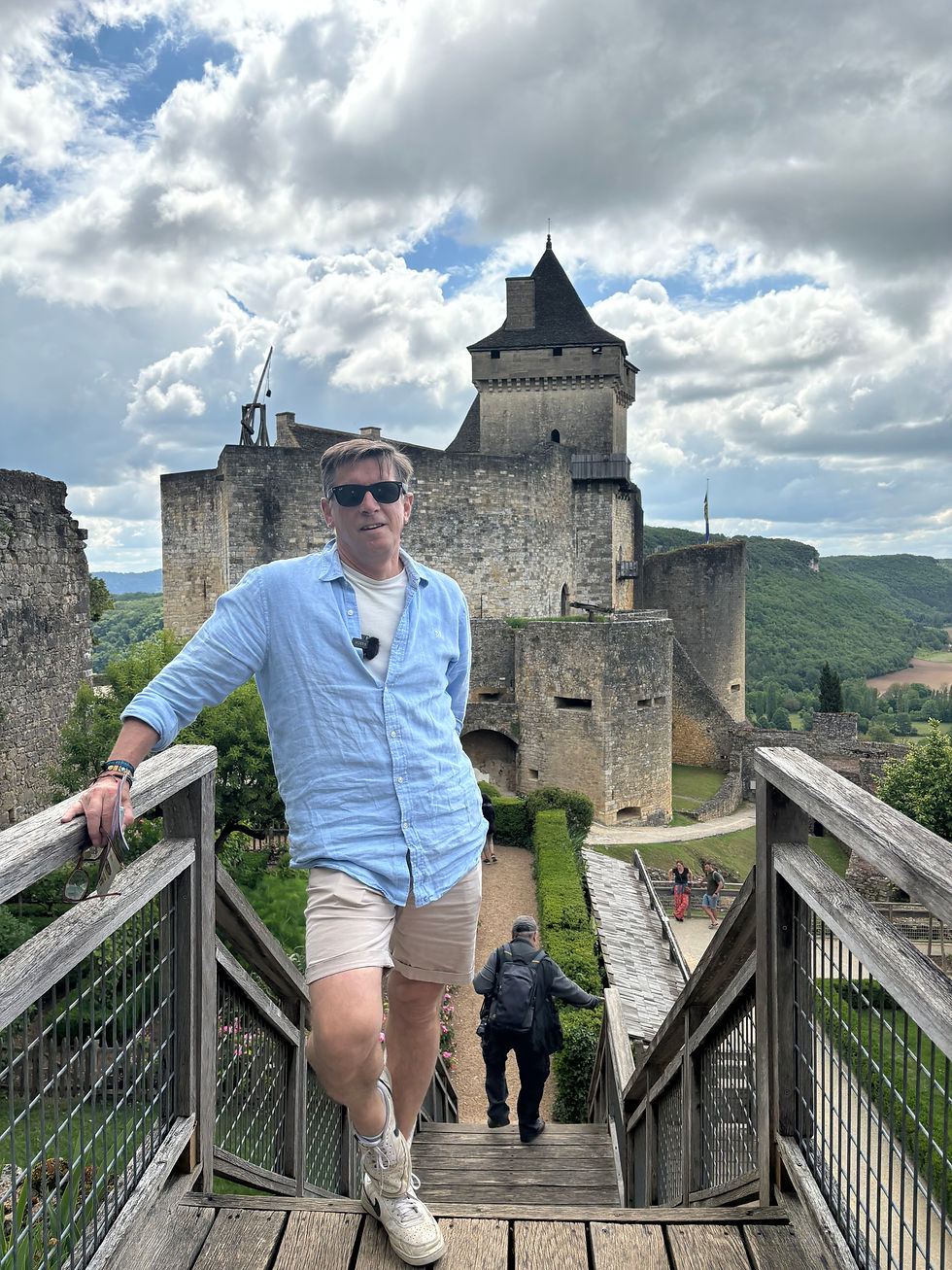
Having fallen into considerable disrepair, it has been carefully brought back to life, allowing visitors to imagine what life would have been like hundreds of years ago. A must see is the trebuchet demonstration

The visit was extremely well organised, with clear information and an English-language guide available.
And, of course, the views from the castle walls were absolutely spectacular.
Our tip: Allow at least two hours to explore the castle properly. It's an excellent attraction for families, particularly children interested in knights, castles and medieval history.
🛶 Canoeing the Dordogne – Our Favourite Way to See the Valley
You really can't visit the Dordogne without spending some time on the river, and for us, canoeing was one of the highlights of our stay.

We hired a canoe from Vitrac and set off on a leisurely journey along one of the most beautiful stretches of the Dordogne.
Teddy came along too, although we're not entirely sure he appreciated the experience quite as much as we did!
The river was wonderfully peaceful, with towering limestone cliffs, wooded hillsides and magnificent castles appearing around almost every bend.

We followed a route that took approximately two and a half to three hours, passing beneath several bridges and enjoying spectacular views of the surrounding countryside.
One of the loveliest things about canoeing the Dordogne is that, when conditions are calm, the gentle current does much of the work for you.

It gives you time to relax, admire the scenery and appreciate just how beautiful this part of France really is. We did have a picnic on route down the river which meant Teddy could stretch his legs.

At the end of our trip, a shuttle bus returned us to the starting point.
Our tip: Canoeing is a fantastic way to explore the valley. Take a waterproof bag for valuables, plenty of water and sun protection. Always check river conditions before setting off.
🍷 Food, Wine & Local Specialities
One of the pleasures of spending an extended period in the Dordogne was having time to enjoy its wonderful food and markets.
The region is famous for its walnuts, duck, foie gras, truffles and rich traditional cuisine.
We loved visiting local markets, picking up fresh produce and discovering regional specialities.
Walnut trees seemed to be everywhere, particularly around our gîte, and we enjoyed learning more about how important they are to the local economy.
Restaurants range from simple village cafés serving generous regional dishes to elegant dining rooms in historic buildings.
And, of course, there was always time for a leisurely lunch and a chilled glass of rosé!
For us, some of the best meals were the simplest: fresh bread, local cheese, a few delicious ingredients from the market and a lovely view.
💡 Our Top Tips for Visiting Sarlat & the Dordogne Valley
Stay somewhere central: Sarlat and the surrounding countryside make excellent bases for exploring the Dordogne Valley. We loved staying near Saint-Nathalène.
Allow plenty of time: Although you can visit the main attractions in a few days, a week or longer allows you to explore at a more relaxed pace.
Hire a car: Having your own transport makes exploring the villages, castles and countryside much easier.
Visit popular villages early: Sarlat, Beynac and La Roque-Gageac can become very busy during the summer.
Bring comfortable walking shoes: Many of the villages have steep, cobbled streets, and some of the best viewpoints involve a climb.
Make time for the river: Whether you choose canoeing, a traditional gabarre trip or simply a riverside picnic, the Dordogne River is at the heart of the region.
Explore beyond the main attractions: Some of our favourite memories came from countryside walks, little villages and places we discovered by chance.
❤️ Our Final Thoughts
After four wonderful weeks exploring this part of the Dordogne, it's easy to understand why so many people fall in love with the region.
For us, it offered the perfect combination of history, beautiful countryside, outdoor adventures and wonderful food.
We loved the freedom of having our own gîte, which gave us the opportunity to work remotely editing videos, spending time with family and discovering somewhere different almost every day.
From the magnificent castles overlooking the river to the beautifully maintained gardens and charming medieval villages, there really is something special about this corner of France.
And despite spending so much time here, we still feel there's plenty left to discover.
The Dordogne is somewhere we'll happily return to again and again.


Comments